
The Basics
|
Ranked Choice Voting (RCV) is a simple upgrade to how we already vote in Georgia. In fact, it's already used by military and overseas voters. With RCV, instead of choosing just one candidate, you rank your choices in the order you prefer them: first, second, third, and so on. Like our runoff system, candidates with the lowest votes are eliminated and votes transfer to the voters' next choice. We get a clearer view of voters' choices so voters get the results we deserve. |
 |
Runoff Problems
Runoffs try to give us majority rule, but they cause major issues:
- Huge Costs: Runoffs waste taxpayer money with double the elections. A statewide runoff costs about $75 million!
- Vanishing Votes: A voter may vote in the general election, but if he/she doesn't return for the runoff, their vote is thrown out!
- Voter Fatigue: With so many elections, voters must go to the polls four to six times a year.
RCV Solutions
RCV provides a simple solution. If your top choice can't win, your vote automatically transfers to your next ranked choice. No need to have a runoff where to say your next preference or restate your existing preference. We have it all in the ranked choice ballots.
RCV maintains majority rule and gives voters more choice, voice, and power by
- Reducing costs: RCV saves up to $75 million per year of taxpayer money by removing runoff elections.
- Counting all votes: Your ballot is never wasted because your vote automatically transfers to your next ranked choice.
- Shortening elections: Having just one election saves voters the hassle of returning to the ballot box. A winner can be declared on election night, rather than weeks later.
Further, voters are free to vote their conscience supporting whichever candidate they like most knowing their vote won't get wasted. Another benefit is that candidates are rewarded for gaining broad support. If a candidate can't get your first choice, the candidate wants your second. This encourages more positive campaigning and leads to a more representative government. In total, it gives voters more choice and empowers their voice. It's is a common sense solution for a healthy democracy.
Watch this short video to see how Ranked Choice Voting works.
Tallying Votes
The vote tally is so simple, it fits in one little picture.
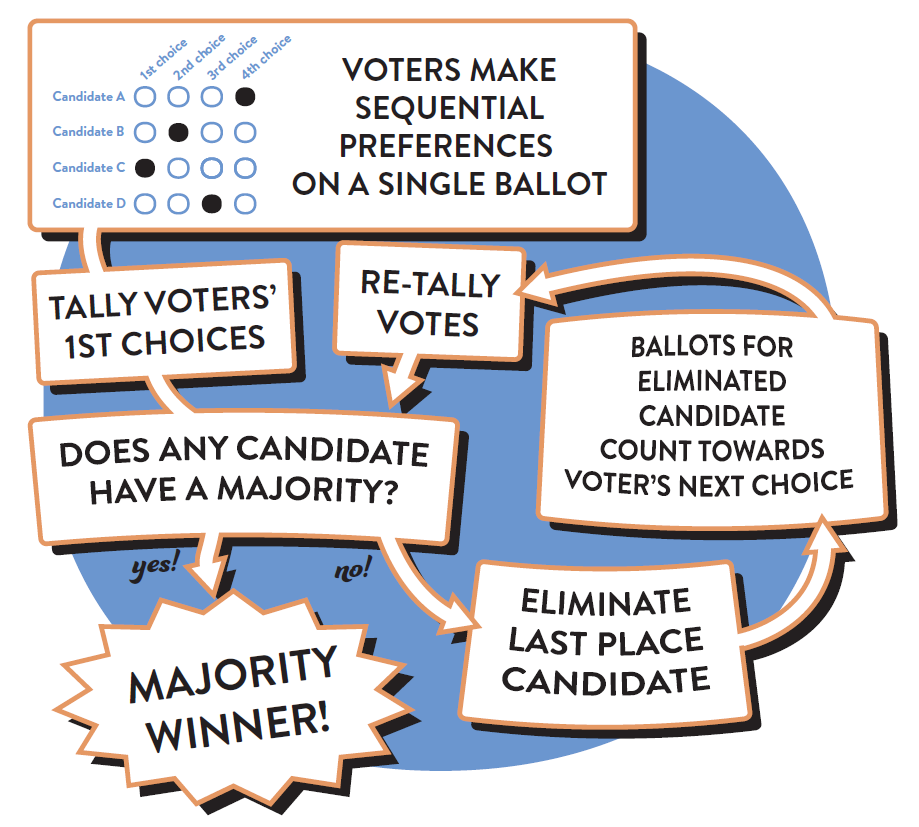
Let's walk through it. If a candidate receives a majority of the first-choice votes, they win the election. If they don't get a majority, the candidate with the fewest votes is eliminated. Any votes for that candidate are instantly transferred to the next ranked choice on that voter's ballot. Remember, we have the whole ranked order on each voter's ballot. Then, if a candidate has a majority, they win. If not, the candidate with the fewest votes is eliminated and votes are transferred. This process continues until a candidate gets more than half of the votes and wins.
RCV is just like having a runoff election but voters only need to come out to vote once.
Additional Resources
For a longer explanation of RCV and its benefits, check out our IRV 101 seminar from a few years ago. (IRV, or instant runoff voting, is another name sometimes used for ranked choice voting.)
Check out our FAQ to learn more about ranked choice voting.
Do you like this page?